


Your UK State Pension could provide a stable foundation for your retirement income.
But if you boost your State Pension by topping up yourNational Insurance record from overseas, there’s a pressing rule change that requires you to act.
The clock is ticking – there’s a deadline, and you may have to rely on snail mail to meet it.
How and when the rules for paying voluntary National Insurance contributions are changing
In a nutshell:
- The (previously cheapest) option to make Class 2 National Insurance contributions (NICs) ended on 6 April 2026.
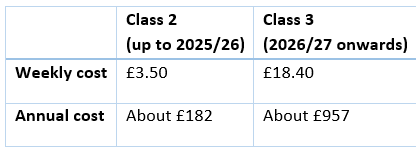
- Now you can only make Class 3 contributions – atroughly five times the cost.
The ability to fill gaps as far back as 2006 closed in April 2025
For several years, the government offered people the opportunity to fill gaps in their NICs as far back as 2006.
Although the window of opportunity was extended twice, the option closed for good on 5 April 2025.
Now the normal rule has returned, meaning you can usually only fill gaps from the last six tax years.
Class 2 has gone for time spent abroad
In the 2025 UK Autumn Budget, then-chancellor Rachel Reeves announced that people would no longer be able to pay cheaper Class 2 NICs for periods spent abroad after 6 April 2026.
So, from the current 2026/27 tax year onwards, Class 3 is your only option.
However, gaps in the years before April 2026 aren’t affected, meaning you still have the chance to fill gaps from previous years under the old rules.
The price differential at a glance:
It’s harder to qualify
The previous rules were pretty straightforward. You could make voluntary NICs from abroad if you’d either:
- Lived in the UK for three consecutive years
- Paid at least three years of contributions.
Now the bar is higher. New applicants need either:
- 10 continuous years of living in the UK
- 10 years of qualifying NICs.
National Insurance credits don’t count, and neither do voluntary contributions paid for time abroad.
If you were already paying Class 2 contributions, the pressure is on
Those who want to avoid being caught by the 10-year test and retain the older (easier!) eligibility rules must apply before 6 April 2027.
Sounds reasonable enough, but there are a couple of snags to negotiate:
- HMRC wrote to around 46,000 people in July 2026, so there’s likely to be a queue.
- To make back-payments for gaps in the current tax year, or to set up future payments by Direct Debit, you might need to use “good” old-fashioned snail mail.
Due to this and other unknowns, we’re encouraging clients to apply early and keep proof of when you submitted – just in case you end up having to prove you took the necessary steps well ahead of the deadline.
Don’t delay – existing HMRC NIC Direct Debits for Class 2 collections have already stopped working
It’s an easy mistake to make – but if you were previously paying Class 2 NICs by Direct Debit, the arrangement doesn’t automatically switch.
This has caught lots of people out.
However, the final Class 2 collection for the 2025/26 tax year was taken on 10 July 2026. That was the last one and signals that your Class 2 arrangement has ceased.
To continue contributing, you need to make a new application using form CF83, which you can do online through the UK government website.
Before you start, check what you need to apply – it’s fairly straightforward, but having everything you need close to hand will make the form-filling easier.
HMRC will then confirm what you can pay and set up the new arrangement.
If you were already paying Class 3 from abroad, good news! That arrangement is unchanged, so no action is required.
Meet the deadline to protect your 3-year rule eligibility
If you were already paying Class 2, you can keep using the older three-year rules instead of the new 10-year rules if all of the following apply:
- You applied to pay Class 2 or Class 3 for2024/25 or 2025/26 on or before 5 April 2026
- You pay those contributions on or before 5 April2027
- You apply to pay Class 3 for 2026/27 on orbefore 5 April 2027.
The important thing to remember is: you must apply before 6 April 2027.
It all sounds like a big administration headache – is it worth it?
While none of this is ideal, the changing rules don’t negate the potential benefits of paying voluntary NICs.
For most people, the potential payback makes it worth jumping through the admin hoops.
Here’s the sum that counts:
- One extra qualifying year adds around £358 a year to the full new State Pension, for a cost of about £957.
- So, you’d generally expect to get your money back in under three years of drawing your pension.
While more expensive than before, the numbers usually still add up.
If in doubt, get in touch, and we’ll look at all your circumstances and advise what it might mean for you.
For example, if you expect to retire outside the UK, in many countries the State Pension is frozen at the rate it starts and doesn’t rise each year as it would in the UK – including Singapore and Australia.
It’s still usually worth paying, but you should review how it fits into your plans.
Next steps
- Check your current State Pension forecast on the government website –there’s no point paying more to fill every gap if it won’t increase your pension.
- Have you got mail? Check to see if you received the HMRC letter that was sent in July 2026. Overseas post isn’t always reliable, so if you haven’t had it, don’t wait for it to arrive now.
- Look back over your July and August bank statements to ensure no further funds have been collected by Direct Debit – the last date this should have occurred was 10 July 2026.
- Apply online using form CF83 – now is good, but if not immediately, make sure you do so well before April 2027 – missing the deadline could prove costly.
- Look out for confirmation that your new Class 3 NIC arrangement is up and running. Don’t simply sit back and assume it will happen – make sure the money is being collected as you expect!
Get in touch
Juggling a successful career with family commitments and an active social life can mean admin gets pushed aside.
Whether you’d like to discuss your options, have someone else do the heavy lifting, or simply need moral support as you navigate the HMRC hoops, please get in touch – we’re here to help.


